I've always loved seeing how common theoretical concepts are actually used in the real world in lesser-known ways. When I was studying computer networks, I came across a perfect example of that.
Distance vector routing (DVR) is a practical implementation of the Bellman-Ford algorithm, a graph-search calculation that finds the shortest path from a source node to all other nodes in a graph. DVR uses a distributed version of the algorithm, where each router is a node with edges to neighboring routers they can connect to. No single router has a full map of the network, so DVR is needed to find the shortest (best) path to any other router on the network.
Since I happened to make a Bellman-Ford visualizer blog post earlier, I knew I had to make one about DVR. This time, I made a project!
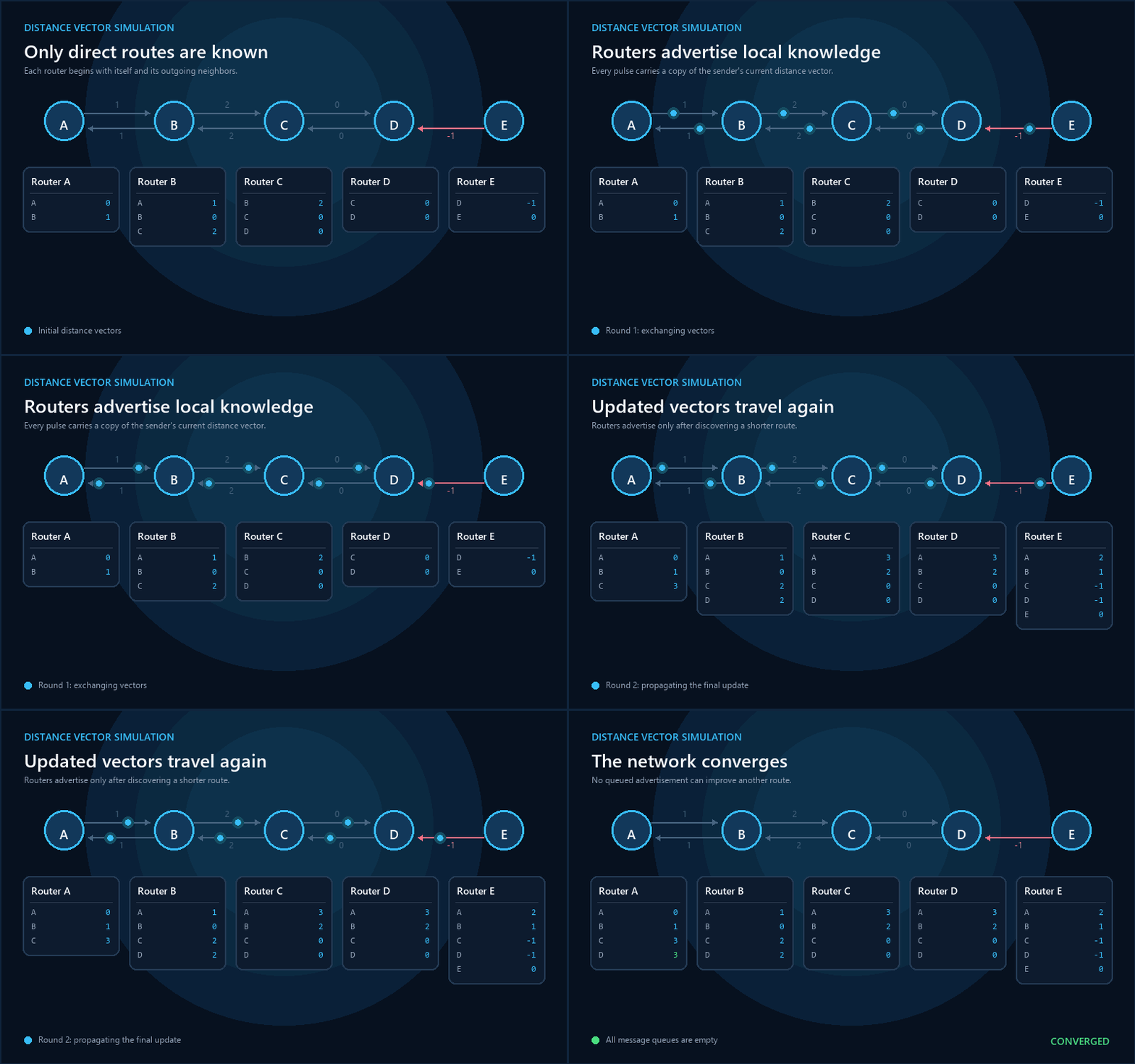
I built a Python simulation where every router starts with only itself and its directly connected neighbors in its distance vector. Routers advertise copies of those vectors to one another, process the incoming messages with the Bellman-Ford equation, and send another update only when they discover a better route. The topology keeps running rounds until every message queue is empty, which makes it satisfying to watch a network converge without any node ever seeing the full graph. I also tested directed links, zero and negative weights (don't ask too many questions about what negative weights represent in a network topology). To handle negative cycles, I used -99 as the stand-in for negative infinity.